English
  عربى
عربى  中文简体
中文简体 
News

What Are Boat Chocks and Why Does Every Boat Owner Need Them?
 2026.03.24
 Industry News
Boat chocks are wedge-shaped or curved support devices placed under a boat's hull to prevent it from rolling, shifting, or sliding during trailering, dry storage, or docking. They are essential safety components that stabilize your vessel, protect the hull, and prevent costly accidents. Whether you own a small fishing boat or a large yacht, boat chocks are a non-negotiable piece of marine safety equipment.
Content
- Understanding Boat Chocks: The Basics
- Types of Boat Chocks: A Comprehensive Comparison
- Boat Chocks for Trailering: What You Need to Know
- Boat Chocks for Dry Storage: Protecting Your Hull Year-Round
- Deck Chocks: Securing Boats on Larger Vessels
- How to Choose the Right Boat Chocks: Buying Guide
- Boat Chock Maintenance and Care
- Frequently Asked Questions About Boat Chocks
- Conclusion: Why Boat Chocks Are Non-Negotiable
Understanding Boat Chocks: The Basics
The term "boat chock" comes from the nautical word "chock," meaning a wedge or block used to prevent movement. In marine applications, boat chocks serve as stabilizing supports that cradle the hull of a vessel and keep it from moving unpredictably. They are used in a wide range of scenarios — from loading a boat onto a trailer to securing it in long-term dry storage or aboard a ship's deck.
Without proper boat chocking, even a securely strapped boat can shift during transit, leading to hull damage, strap failures, or catastrophic accidents on the road. In storage environments, an unchocked boat may slowly tilt or roll, putting uneven stress on the hull, keel, or supports.
Key Functions of Boat Chocks
- Stabilization: Prevent lateral and longitudinal movement of the hull during transport or storage.
- Hull Protection: Distribute the weight of the vessel evenly to avoid pressure points and hull deformation.
- Safety: Reduce the risk of boat tipping or falling off trailer bunks or storage stands.
- Load Security: Work in conjunction with tie-down straps to create a fully secured load.
- Deck Use: On larger vessels, deck chocks secure smaller boats (tenders, dinghies) against the motion of the sea.
Types of Boat Chocks: A Comprehensive Comparison
Not all boat chocks are the same. Each type is designed for specific applications, vessel sizes, and surfaces. Understanding the differences helps you choose the right chock for your needs.
Boat Chocks for Trailering: What You Need to Know
When transporting a boat on a trailer, trailer boat chocks are among the most important pieces of safety equipment you can own. Even with quality roller or bunk trailers, vibration and road movement can cause a boat to shift, bounce, or work loose from its tie-downs.
How to Properly Chock a Boat on a Trailer
- Position the boat evenly on the trailer, centered both laterally and longitudinally.
- Place chocks against the bow and stern of the hull on both port and starboard sides.
- Ensure snug contact — chocks should be tight enough to prevent movement but not so tight that they deform the hull.
- Combine with tie-down straps over the gunwales or through dedicated tow points for maximum security.
- Re-check after 10–15 miles of initial driving, as vibration can slightly loosen the setup.
Safety Tip: Never rely solely on boat chocks for trailering. They must always be used in conjunction with properly rated tie-down straps and a bow safety chain. Chocks are a critical layer of protection, not the only one.
Boat Chocks for Dry Storage: Protecting Your Hull Year-Round
Long-term dry storage is one of the most critical applications for boat chocks. When a boat sits out of the water for weeks or months, the hull bears the full weight of the vessel on a small number of contact points. Without proper support and chocking, this can lead to:
- Hull deformation — fiberglass or aluminum hulls can slowly flatten or warp under uneven load.
- Osmotic blistering — in fiberglass boats, stress points can trap moisture and cause blistering.
- Keel damage — sailboats especially need their keels properly supported with chocks to prevent cracking.
- Toppling risk — tall-sided vessels can be vulnerable to wind, accidental contact, or uneven ground.
Boat Storage Chock Placement Guide
Deck Chocks: Securing Boats on Larger Vessels
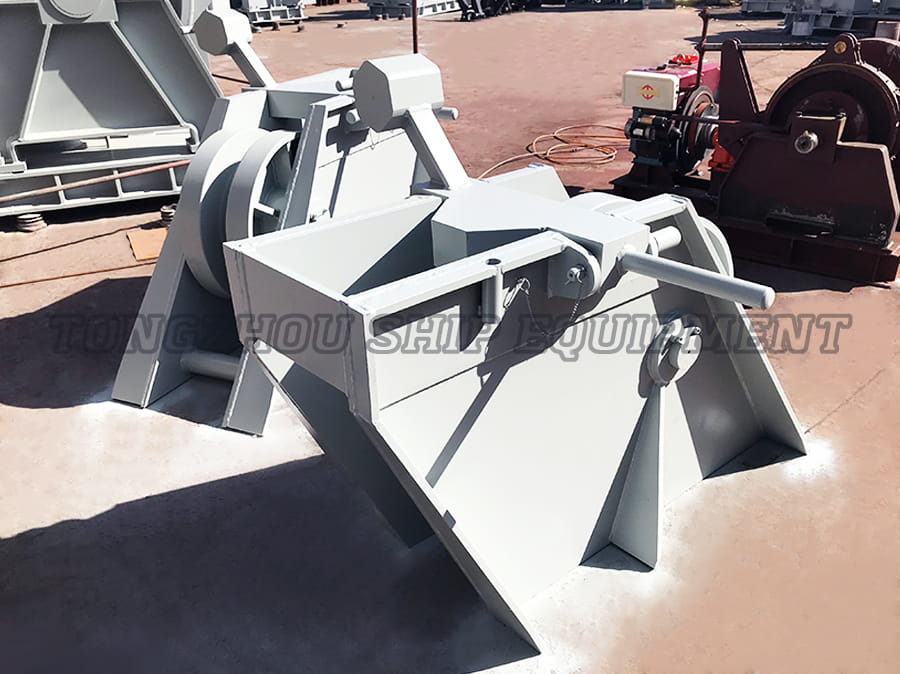
On larger ships, ferries, and offshore platforms, deck boat chocks are used to secure smaller vessels — tenders, rescue boats, or workboats — against the constant motion of the sea. These are typically heavy-duty metal or reinforced polymer units that are bolted or welded to the deck.
Marine-grade deck chocks must meet strict load ratings and are often used alongside lashing straps, cradles, and securing pins. In commercial applications, they may be subject to international maritime safety standards.
Deck Chocks vs. Trailer Chocks: Key Differences
How to Choose the Right Boat Chocks: Buying Guide
With so many options available, selecting the right boat chocks can be challenging. Here are the most important factors to consider:
1. Boat Size and Weight
Always match the chock load rating to your vessel's weight. A chock rated for a small aluminum fishing boat is not suitable for a 30-foot fiberglass cruiser. Most manufacturers clearly list maximum weight ratings on their products.
2. Hull Shape
V-hull, flat-bottom, cathedral hull, and round-bilge boats all require different chock profiles. Some boat chocks are designed with adjustable angles to accommodate multiple hull forms. Custom-shaped chocks offer the best fit and load distribution for unusual hull designs.
3. Storage Environment
Outdoor storage requires UV-resistant materials like high-density polyethylene (HDPE). Indoor storage is more forgiving and allows for a wider range of materials. Salt air environments demand corrosion-resistant options — avoid untreated steel in marine settings.
4. Surface Contact and Hull Protection
For gelcoat and painted hulls, always choose foam-padded or rubber-coated boat chocks. Hard plastic or metal chocks placed directly against a polished hull can cause scratching, pressure marks, or cosmetic damage. Carpet-covered chocks are another popular choice for protecting delicate finishes.
5. Portability Requirements
If you frequently move your boat between locations, lightweight and compact boat chocks are preferable. Hollow rubber or PE chocks that nest together are easy to store and transport. For permanent installations, heavier and more robust materials are the better choice.
Boat Chock Maintenance and Care
Like all marine equipment, boat chocks require regular inspection and maintenance to remain effective and safe. Here are best practices for keeping your chocks in top condition:
- Inspect for cracks or deformation before each use, especially after heavy loads or temperature extremes.
- Clean with mild soap and water to remove salt, grime, and mildew that can degrade materials over time.
- Apply UV protectant to rubber and plastic chocks exposed to sunlight to extend their lifespan.
- Replace foam padding when it shows signs of compression or deterioration — compressed foam no longer provides adequate protection.
- Store dry when not in use to prevent moisture accumulation, mold, and material breakdown.
Frequently Asked Questions About Boat Chocks
Conclusion: Why Boat Chocks Are Non-Negotiable
Boat chocks may be simple in concept, but their role in marine safety is profound. From the moment your vessel leaves the water — whether being loaded onto a trailer, placed in seasonal storage, or secured on a ship's deck — chocks are what stand between a safely stabilized boat and a potentially catastrophic accident.
Choosing the right type of boat chock, placing them correctly, and maintaining them properly is not optional for any responsible boat owner. The investment in quality boat chocking equipment is minimal compared to the cost of hull repairs, property damage, or the risk to human safety that a poorly secured vessel represents.
Whether you are a weekend recreational boater or a commercial marine professional, understanding and applying proper boat chock practices is one of the most important steps you can take to protect your vessel, your investment, and the people around you.

-
Corporate Email:
-
Sales Email:
-
Address:No. 16 Kesheng Road, Development Zone, Xinghua City, Jiangsu Province, China