English
  عربى
عربى  中文简体
中文简体 


An anchor connector is a load-bearing hardware device that creates a secure attachment point between a lifeline, lanyard, or rope system and a fixed structural anchor -- serving as the critical link in fall protection systems, rigging assemblies, marine mooring setups, and rope access operations. The right anchor connector must meet the applicable load rating for its use: in fall protection, connectors must withstand a minimum 5,000 lbf (22.2 kN) static load per OSHA 29 CFR 1926.502 and ANSI Z359.1; in rigging and structural applications, ratings range from 1,000 lbf to over 200,000 lbf depending on material, geometry, and working load limit (WLL).
This guide explains what anchor connectors are, how each major type works, compares their load ratings and material options, covers installation best practices, and answers the questions safety managers, riggers, and contractors ask most frequently.
Content
- What Does an Anchor Connector Do? Core Function and Safety Role
- Which Types of Anchor Connectors Are Available?
- How Do Anchor Connector Types Compare? Full Specification Table
- Why Material Selection Is Critical for Anchor Connector Performance
- How to Select the Correct Anchor Connector: A Step-by-Step Decision Framework
- What Are the Most Common Anchor Connector Failure Modes -- and How to Prevent Them?
- FAQ: Anchor Connector Selection and Use
- Why Getting Your Anchor Connector Selection Right Is Non-Negotiable
What Does an Anchor Connector Do? Core Function and Safety Role
An anchor connector translates the mechanical energy of a fall, load, or tension event into a controlled force transfer between the worker or load and the structural anchor point -- without which the entire safety or rigging system has no fixed reference point and cannot function.
In practical terms, an anchor connector performs three simultaneous functions:
- Load transmission: It transfers tensile, shear, and impact forces from the lifeline or rigging component to the structural anchor (beam, eyebolt, concrete anchor, or anchor plate) without deforming, opening, or fracturing under rated load.
- Geometric adaptation: Anchor connectors bridge dimensional incompatibilities between the rope, webbing, or hardware and the anchor point -- allowing a carabiner to connect a 16mm rope to a 20mm eyebolt, for example, or a shackle to connect a wire rope to an anchor plate with a different hole geometry.
- Quick connection and release: Most anchor connectors are designed for rapid connection and, where required, controlled release -- critical in rescue operations, rope access work, and situations where equipment must be repositioned frequently.
The anchor connector is typically the weakest engineered link in a fall protection or rigging chain -- by design. It is rated, inspected, and replaced on schedule so that if any component yields under overload, it is the connector (which is replaceable) rather than the structural anchor (which may not be).
Which Types of Anchor Connectors Are Available?
Anchor connectors are broadly divided into six categories based on their locking mechanism, load geometry, and intended application -- and selecting the wrong category for a given use case can result in connector failure, cross-loading, or accidental release under load.
1. Carabiner-Style Anchor Connectors
The most widely used anchor connector in fall protection, rope access, and recreational climbing. A carabiner consists of a metal loop with a spring-loaded gate that opens for connection and closes automatically. Safety (locking) carabiners add a threaded sleeve, twist-lock, or magnetic mechanism that prevents accidental gate opening.
- Strength ratings: Industrial-grade locking carabiners for fall protection are rated at a minimum of 25 kN (5,620 lbf) major axis, typically stamped on the body. Recreational carabiners range from 20 to 40 kN major axis.
- Critical limitation: Carabiners loaded on the minor axis (across the gate) have ratings as low as 7 to 10 kN -- a 60 to 75% reduction. Anchor connector installations must prevent cross-loading through correct rigging geometry.
- Common standards: ANSI Z359.12, EN 362, NFPA 1983 (rescue), UIAA 121.
2. Shackle Anchor Connectors
Bow shackles (Omega shackles) and D-shackles are the dominant anchor connector type in rigging, marine, and heavy construction. A shackle consists of a U-shaped body closed by a threaded pin or bolt. Working load limits range from 0.33 tons to 150 tons depending on size and material.
- Bow vs. D-shackle: Bow shackles accept multi-leg slings and multi-directional loads better than D-shackles, which are optimized for in-line tensile loads. For anchor point connections with angular loading, a bow shackle is the correct choice.
- Screw pin vs. bolt and nut: Screw pin shackles are faster to rig but can back out under dynamic or rotational loading. Bolt and nut (safety pin) shackles are required for permanent or semi-permanent rigging where vibration or rotation could loosen a standard screw pin.
- Common standards: ASME B30.26, EN 13889, Federal Specification RR-C-271.
3. Snap Hook Anchor Connectors
Snap hooks are single-action or double-action spring-loaded connectors widely used in personal fall arrest systems (PFAS) to attach lanyards to dorsal D-ring harnesses, horizontal lifelines, and anchor rings. OSHA mandates that snap hooks used in fall protection be double-action self-closing and self-locking to prevent rollout and back-out failures.
- Strength rating: Minimum 5,000 lbf (22.2 kN) per OSHA 1910.140 and ANSI Z359.12.
- Rollout risk: Older single-action snap hooks can roll out of D-rings when subjected to torque or oblique loading. All current OSHA-compliant snap hooks are self-locking, requiring two deliberate actions to open the gate.
- Compatibility: Snap hooks must be compatible with the connecting element (D-ring, beam anchor, anchor ring). Incompatible size or geometry causes cross-loading and is prohibited under OSHA 1926.502(d)(4).
4. Swivel Anchor Connectors
Swivel connectors incorporate a 360-degree rotating element between the anchor attachment and the lifeline connection. They eliminate rope and lanyard twisting under dynamic loading conditions -- critical in rope access, suspended work platforms, and applications where the worker rotates relative to the anchor.
- Strength consideration: The swivel bearing must be rated for the full system load. Industrial swivel anchor connectors are typically rated at 15 to 40 kN. Never substitute a non-rated swivel (such as a fishing swivel) in a safety application.
- Ball bearing vs. plain bearing: Ball bearing swivels rotate more freely under low load but can seize if contaminated. Plain bearing (bushed) swivels are more robust in dirty and corrosive environments.
5. Anchor Plate and Strap Connectors
Anchor plates are flat or formed steel or aluminum plates with multiple attachment holes, designed to distribute load across a large area of structural surface. Anchor straps (web slings looped around structural members) serve the same function for beam and column anchoring without requiring drilled holes.
- Typical WLL: Steel anchor plates: 5,000 lbf to 60,000 lbf depending on plate size and bolt pattern. Web strap anchor slings: 3,600 lbf to 21,200 lbf per leg depending on strap width and webbing grade.
- Installation requirement: Anchor plates require engineering verification of the underlying structure's capacity to accept the bolt pattern and load -- the anchor plate itself is rated, but the substrate (concrete, steel, wood) must be confirmed capable of accepting the load.
6. Structural Beam Anchor Connectors
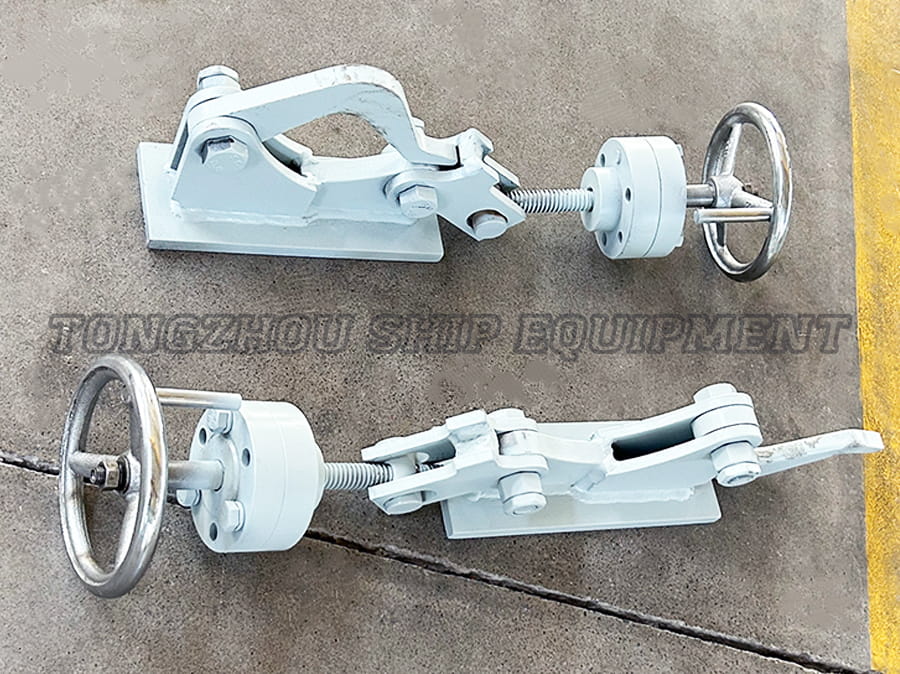
Beam clamp anchor connectors grip steel I-beams or H-beams using a mechanical clamping mechanism, providing an anchor connector point on existing structural steelwork without drilling, welding, or permanent modification. Load ratings range from 5,000 lbf to 25,000 lbf depending on beam flange width and clamp design.
- Flange width compatibility: Each beam clamp anchor connector specifies a minimum and maximum flange width. Using a clamp outside its flange range results in inadequate clamping force and potential slip failure under load.
- Common applications: Steel erection, industrial maintenance, overhead crane runways, and shipbuilding where temporary attachment to structural steel beams is required.
How Do Anchor Connector Types Compare? Full Specification Table
The table below provides a direct comparison of all six major anchor connector types across load rating, primary material options, locking mechanism, best application, and applicable standards -- enabling side-by-side specification decisions.
| Anchor Connector Type | Typical Load Rating | Materials | Locking Mechanism | Primary Application | Key Standard |
| Locking Carabiner | 20--40 kN major axis | Aluminum, steel | Screw, twist-lock, magnetic | Fall protection, rope access | ANSI Z359.12 / EN 362 |
| Bow Shackle | 0.33--150 ton WLL | Carbon steel, alloy steel, SS | Screw pin or bolt-nut | Rigging, marine, heavy lifting | ASME B30.26 / EN 13889 |
| Self-Locking Snap Hook | 5,000 lbf (22.2 kN) min | Steel, aluminum | Double-action self-locking gate | Personal fall arrest (PFAS) | OSHA 1926.502 / ANSI Z359.12 |
| Swivel Connector | 15--40 kN | Steel, stainless steel | Integrated locking carabiner ends | Rope access, suspended platforms | EN 362 / ANSI Z359.12 |
| Anchor Plate / Strap | 5,000--60,000 lbf | Steel, aluminum, nylon webbing | Bolt-fixed or loop-around | Structural anchor points, beams | ANSI Z359.15 / EN 795 Class A |
| Beam Clamp Anchor | 5,000--25,000 lbf | Forged steel, alloy steel | Mechanical clamp (screw-adjusted) | Steel erection, industrial maintenance | ANSI Z359.15 / EN 795 Class B |
Table 1: Full specification comparison of six major anchor connector types by load rating, material options, locking mechanism, primary application, and applicable standard.
Why Material Selection Is Critical for Anchor Connector Performance
The material of an anchor connector determines its corrosion resistance, weight, maximum load rating, and suitability for specific environments -- and using the wrong material can result in connector failure through corrosion, stress corrosion cracking, or hydrogen embrittlement long before the rated load is reached.
Carbon Steel
The most common material for rigging shackles, beam clamps, and anchor rings. Carbon steel offers high strength and low cost but requires surface protection (galvanizing, zinc plating, or paint) in corrosive environments. Hot-dip galvanized steel shackles are standard for marine and outdoor rigging. Carbon steel anchor connectors must not be used in contact with acids, caustics, or in environments where hydrogen sulfide (H2S) is present without material certification.
Alloy Steel
Quenched and tempered alloy steel is used for high-strength rigging shackles (Grade 8, Grade 10, Grade 12) and industrial anchor connectors where the goal is maximum load rating in a compact, lighter body. A Grade 10 alloy steel shackle of a given size has 25 to 40% higher WLL than an equivalent Grade 6 carbon steel shackle. Alloy steel connectors must never be welded, heated, or repaired -- doing so destroys the heat treatment and dramatically reduces load capacity.
Stainless Steel
Grade 316 stainless steel anchor connectors are the standard for marine, food processing, pharmaceutical, and chemical environments where corrosion resistance takes priority over maximum strength-to-weight ratio. Important limitation: stainless steel is susceptible to stress corrosion cracking (SCC) in chloride-rich environments (seawater) under sustained high tensile load -- a failure mode that is invisible until sudden fracture. Regular inspection intervals are mandatory for stainless anchor connectors in marine service.
Aluminum
7075-T6 and 7068 aircraft-grade aluminum carabiners offer the highest strength-to-weight ratio of any connector material, with major axis strengths of 25 to 60 kN at approximately one-third the weight of steel. Aluminum anchor connectors are the default in rope access, rescue, and arborist applications where the worker carries equipment. Limitations: aluminum is not suitable for rigging with wire rope, chain, or other steel components that abrade the soft aluminum gate and body; it cannot be welded; and it degrades in contact with sodium hydroxide (caustic soda) cleaning solutions.
| Material | Strength Level | Corrosion Resistance | Weight | Best Environment | Key Limitation |
| Carbon Steel | High | Low (needs coating) | Heavy | Industrial rigging, construction | Rust without surface protection |
| Alloy Steel (Grade 8-12) | Very High | Low (needs coating) | Heavy | Heavy lifting, compact high-WLL | No welding or repair permitted |
| Stainless Steel (316) | Moderate-High | Very High | Heavy | Marine, food, chemical | SCC risk under sustained load in Cl- |
| Aluminum (7075/7068) | High (by weight) | Moderate | Very Light | Rope access, rescue, arborist | Abrades against steel wire rope |
Table 2: Material comparison for anchor connectors by strength, corrosion resistance, weight, optimal environment, and key limitation.
How to Select the Correct Anchor Connector: A Step-by-Step Decision Framework
Correct anchor connector selection requires evaluating six parameters in sequence -- load magnitude, load direction, connection geometry, environment, regulatory requirement, and inspection interval -- and choosing a connector that satisfies all six simultaneously.
- Step 1 -- Define the design load: For fall protection, the system must withstand a minimum 5,000 lbf (22.2 kN) static load per OSHA. For rigging, calculate the maximum line pull in the most loaded leg of the system, including dynamic factors (a safety factor of 5:1 is standard for alloy chain and shackles; 3:1 or 4:1 for synthetic slings). The connector WLL must be equal to or greater than the maximum calculated load per leg.
- Step 2 -- Determine the load angle: Angular loading reduces the effective WLL of all anchor connectors. A carabiner loaded at 30 degrees to its major axis loses approximately 15 to 25% of rated capacity. Shackle bow bodies accept angular loading better than D-shackles, which are rated only for in-line tensile loads. Always ensure the connector type matches the expected load angle.
- Step 3 -- Check connection geometry: The anchor connector must physically fit the connecting elements at both ends -- the anchor point (eyebolt, beam, plate) and the lifeline or rigging component (rope, web sling, chain). Incompatible sizes create cross-loading conditions. Use connection adapters or shackle reducers where dimensional mismatches exist rather than forcing an ill-fitting connector.
- Step 4 -- Assess the environment: Corrosive environments (salt air, chemicals, acids) require stainless steel or coated alloy connectors. High-temperature environments (above 400 degrees F / 204 degrees C) require connectors rated for elevated temperature -- standard galvanized carbon steel loses significant strength at high temperature. Cryogenic applications require special steel grades certified for low-temperature toughness.
- Step 5 -- Confirm regulatory requirement: Verify which standard governs the application. Fall protection connectors must meet OSHA 29 CFR 1926.502 and ANSI Z359 series. Marine rigging must meet Lloyd's Register or ABS requirements. Crane rigging must comply with ASME B30.9 and B30.26. Use only connectors that carry the required certification marks.
- Step 6 -- Establish inspection interval: OSHA 1910.140 requires that personal fall protection connectors be inspected before each use and by a competent person at intervals not exceeding one year. Rigging hardware per ASME B30.9 requires inspection before each lift. Any connector showing deformation, cracks, corrosion pitting, gate malfunction, or illegible markings must be removed from service immediately and destroyed.
What Are the Most Common Anchor Connector Failure Modes -- and How to Prevent Them?
The five most common anchor connector failure modes are cross-loading, gate failure, corrosion-induced fracture, shock overload, and improper connection geometry -- and every one of them is preventable through correct selection, installation, and inspection.
Cross-Loading
Loading a carabiner or snap hook on the minor axis (gate side) instead of the major axis can reduce rated strength by 60 to 80%. This is the single most common cause of anchor connector failure in fall protection. Prevention: use a swivel anchor connector or a connector with a captive eye that cannot rotate into the minor axis position. Ensure anchor points are positioned to maintain consistent load direction.
Gate Failure (Rollout and Back-Out)
A carabiner gate that opens under load allows the rope or sling to roll out of the connector body. This failure mode was responsible for numerous fatalities before self-locking carabiners became the standard. Prevention: use only double-action self-locking carabiners and snap hooks; inspect gate function before every use; retire any connector with a gate that does not close positively and lock automatically.
Corrosion-Induced Fracture
Pitting corrosion on the bearing surfaces of shackle pins or carabiner gates creates stress concentration points. Fatigue cracks initiate at these pits and propagate under cyclic loading. A connector that appears only mildly corroded on the surface may have lost 30 to 50% of its rated capacity. Prevention: inspect for pitting at every use; do not clean corrosion with abrasives that remove surface metal; retire any connector with visible corrosion pitting regardless of apparent depth.
Shock Overload
A fall arrest event subjects the anchor connector to a peak dynamic force several times the static load. A 220 lb (100 kg) worker falling 6 feet on a standard lanyard generates approximately 900 to 1,800 lbf (4 to 8 kN) peak arrest force at the anchor connector with a shock-absorbing lanyard -- well within the 5,000 lbf rating. However, a free fall on a non-energy-absorbing system generates forces exceeding 3,600 to 7,200 lbf (16 to 32 kN) -- approaching or exceeding connector ratings. Any connector subjected to a fall arrest event must be taken out of service and inspected or replaced regardless of visible damage.
Screw Pin Backing Out
Shackle screw pins can rotate and back out under vibration, dynamic loading, or rotational forces from the rigging load -- especially in applications where the sling rotates around the shackle during a lift. Prevention: use bolt-and-nut (safety pin) shackles for all applications involving rotation or vibration; where screw pins must be used, secure them with a mousing wire through the pin hole; torque screw pins to the manufacturer's specification (typically finger-tight plus one quarter turn).
FAQ: Anchor Connector Selection and Use
Q: What is the difference between an anchor connector and an anchor point?
An anchor point is the fixed structural element to which the fall protection or rigging system is attached -- the I-beam, concrete anchor, roof anchor socket, or engineered anchor plate embedded in the structure. An anchor connector is the hardware device (carabiner, shackle, snap hook, beam clamp) that physically bridges the anchor point and the lifeline, lanyard, or sling. A complete system requires both: a rated anchor point with sufficient structural capacity and a rated anchor connector appropriate for the geometry, load, and environment.
Q: How do I know if an anchor connector is rated for fall protection?
Fall protection-rated anchor connectors must carry a minimum 5,000 lbf (22.2 kN) static load rating and comply with ANSI Z359.12 (for connectors in personal fall arrest systems) or ANSI Z359.15 (for anchor devices). Look for the following on the connector body: the rated load in kN stamped or engraved on the body; the applicable ANSI or EN standard designation; and a compliance mark from a third-party testing laboratory. General-purpose carabiners, recreational climbing carabiners, and utility hooks do not meet fall protection requirements regardless of their stated strength if they lack the required certification. A carabiner without a locking gate is explicitly prohibited by OSHA 1926.502(d)(4) for fall protection use.
Q: Can you reuse an anchor connector after it has been involved in a fall arrest event?
No -- OSHA and ANSI Z359 standards require that any personal fall arrest system component, including anchor connectors, be removed from service immediately after a fall arrest event and inspected by the manufacturer or a competent person before any reuse is considered. The dynamic forces in a fall arrest event can introduce microscopic deformation, gate damage, or internal cracking that is not visible to the naked eye but significantly reduces residual load capacity. Most manufacturers recommend destruction and replacement rather than reuse after any fall arrest, regardless of apparent condition. For rigging hardware subjected to shock loading above the rated WLL, the same principle applies.
Q: What is the service life of an anchor connector?
Service life depends on connector type, material, use frequency, and environment. ANSI Z359.12 does not mandate a specific calendar-based retirement date for connectors -- retirement is based on condition, not age alone. However, many manufacturers recommend retiring aluminum carabiners after 10 years from the date of manufacture regardless of condition, because cumulative UV exposure and anodizing degradation are difficult to assess visually. Steel shackles used in permanent rigging should be inspected annually per ASME B30.26 and replaced when wear, corrosion, or deformation is detected. Snap hooks and carabiners must be retired immediately if: the gate does not close and lock positively; the body shows bends, cracks, or corrosion pitting; the markings are illegible; or the item has been involved in a fall arrest.
Q: Is a stainless steel anchor connector always better than carbon steel for outdoor use?
Not necessarily. Stainless steel offers superior corrosion resistance but typically has a lower WLL than alloy steel of the same dimensions, and costs significantly more. Hot-dip galvanized carbon steel shackles and connectors are the industry standard for most outdoor rigging and construction applications -- the zinc coating provides effective corrosion protection in most environments for years of service at a fraction of stainless cost. Stainless steel is the preferred choice specifically for: saltwater marine environments; food and pharmaceutical processing (due to cleaning chemical compatibility); and architectural applications where appearance matters. For offshore rigging subjected to sustained load in seawater, duplex stainless steel or super duplex grades are specified over standard 316 to reduce stress corrosion cracking risk.
Q: How many anchor connectors can be stacked on a single anchor point?
OSHA 1926.502 limits the number of workers attached to a single anchor point based on the anchor's structural capacity -- each attached worker requires a minimum 5,000 lbf anchor capacity. Stacking multiple connectors on a single eyebolt or anchor ring is physically possible but creates several problems: the connectors can press against each other (trilobite loading), reducing each connector's effective load capacity; rotation of one connector can apply unexpected angular loads to adjacent connectors; and the anchor point must support all attached loads simultaneously. For multi-worker anchor points, use engineered horizontal lifelines, trolley systems, or anchor plates with individual rated attachment points for each worker rather than stacking connectors on a single eye.
Why Getting Your Anchor Connector Selection Right Is Non-Negotiable
The anchor connector is the single component that physically joins every other element of a fall protection or rigging system to the fixed structure -- its failure means the entire system fails, with no redundancy and no second chance.
The investment in correctly specified, certified, and regularly inspected anchor connectors is modest compared to the human and financial cost of a single failure event. A certified locking carabiner costs $15 to $80; a rated shackle costs $8 to $200 depending on size; a beam clamp anchor connector costs $60 to $400. These are insignificant costs relative to the engineering and regulatory requirements they satisfy and the lives they protect.
For safety managers, the key takeaways from this guide are: specify connectors by certification standard and rated load, not by price or appearance; train workers to inspect connectors before every use; establish a documented connector retirement policy based on manufacturer guidelines and applicable standards; and maintain an inventory of rated connectors appropriate for the specific geometries and environments your team encounters.
For rigging engineers and upfitters, always verify the full load path from anchor point through every anchor connector to the load -- the system is only as strong as its weakest link, and that link must be engineered, not estimated.